Garage Door R-Value Explained | Best Insulation for Texas Heat
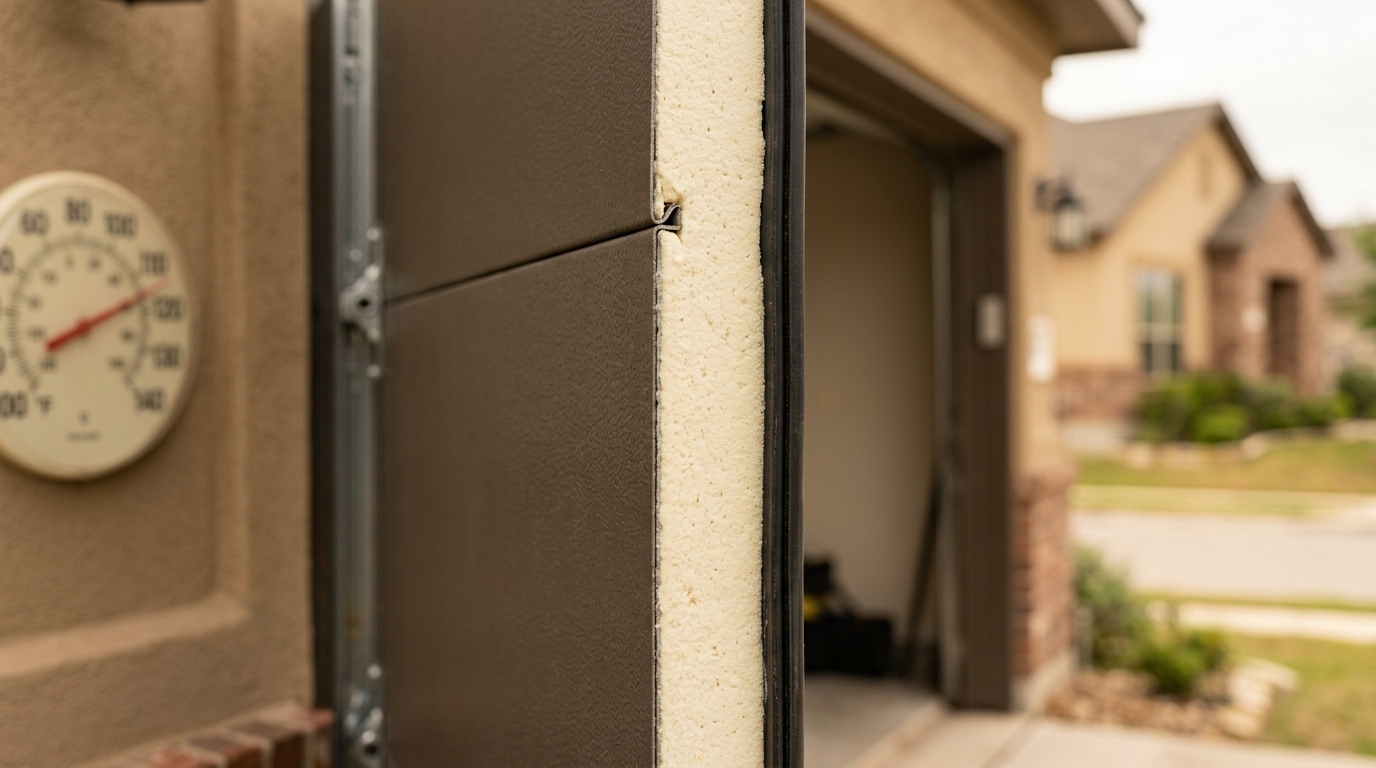
If you are replacing a garage door in Texas, insulation is not optional — it is one of the most impactful decisions you will make. Texas summers create conditions where an uninsulated attached garage can become a 140°F heat sink, driving up your HVAC costs and making adjacent rooms uncomfortably warm. Understanding R-value helps you pick the right door for your home.
What Is R-Value in a Garage Door?
R-value measures thermal resistance — how well a material resists heat transfer. Higher R-value means better insulation. For garage doors, R-value is determined by the insulation material and thickness inside the steel panels.
Garage doors are typically available in these R-value tiers:
| R-Value | Insulation Type | Typical Thickness | Best For |
|---|---|---|---|
| R-0 | None (uninsulated) | Single-layer steel | Detached garages, budget builds |
| R-6 | Polystyrene foam board | Two-layer (steel + foam + steel or vinyl) | Basic improvement over uninsulated |
| R-9 | Polystyrene or polyurethane | Two-layer | Moderate improvement |
| R-13 | Polyurethane injected | Two-layer steel, fully injected | Recommended for Texas attached garages |
| R-18 | Dense polyurethane | Two-layer, premium thickness | Maximum insulation, best for extreme heat |
How R-Value Affects Your Texas Home
Houston: Humidity and Heat
Houston averages high temperatures above 90°F for approximately 150 days per year, with humidity creating a real-feel (heat index) of 100–110°F on many summer days. An attached garage facing south or west with an uninsulated door becomes a radiant heat source for the adjacent wall and rooms.
A door with R-13 or higher reduces heat transfer through the door by 90%+ compared to an uninsulated door. This meaningfully reduces HVAC load for the adjacent interior space.
Austin: Extreme Dry Heat
Austin’s lower humidity does not provide any relief — in fact, the dry air holds heat differently, and actual temperatures regularly exceed 105°F in July and August. The limestone exterior common in many Austin homes retains heat effectively, compounding the thermal load on the garage.
For Austin homes with attached garages, R-13 is a minimum recommendation. R-18 is worth considering if the garage is below or adjacent to living space.
R-Value Comparison: Real-World Impact
Theoretical R-values are calculated in controlled conditions. Real-world performance in a Texas summer depends on additional factors:
- Door color: Dark doors absorb significantly more solar heat than light colors. If you have a south- or west-facing garage with a dark door, even an R-18 unit will transmit more heat than a light-colored R-9 door.
- Door sealing: Thermal performance is compromised by gaps at the sides and bottom. High R-value doors with worn weather stripping underperform their rating significantly.
- Garage ventilation: If the garage is ventilated (attic vent, door gap, etc.), the door’s R-value matters less to interior temperature.
ROI Analysis for Texas Homeowners
The incremental cost of stepping up from an uninsulated to an R-13 door is typically $300–$600. The energy savings depend on your HVAC setup, garage use, and utility rates, but for an attached garage where the door wall is adjacent to living space:
- Estimated annual HVAC savings: $80–$200 (varies significantly by home and usage)
- Payback period: 2–6 years at current Texas energy rates
Austin’s higher summer temperatures and longer cooling season push the payback period toward the shorter end. Houston’s longer overall heat season has similar math.
What Door Construction Delivers the Highest R-Value?
Three-layer polyurethane injection is the construction method that achieves R-13 and R-18 ratings in standard-thickness doors. The polyurethane is injected between two steel skins as a liquid and expands to fill the cavity completely — this is more effective than polystyrene foam boards, which can shrink or fall away from the steel over time.
Look for doors that specify polyurethane injection (not polystyrene board) for R-13 and above.
Our Recommendation for Texas Homeowners
- Detached garage: R-6 or R-9 is sufficient. You are not conditioning the space.
- Attached garage, budget-conscious: R-9 minimum.
- Attached garage, Houston or Austin: R-13 standard. R-18 for premium performance.
- Garage below living space: R-18 minimum.
- Garage used as workshop or gym: R-13 minimum; also consider garage ventilation.
Related Reading
- Garage Door Installation Cost Guide 2026
- New Garage Door Installation in Houston
- New Garage Door Installation in Austin
Ready to Upgrade?
Mockingbird Garage Doors installs all R-value tiers in Houston and Austin. Call (713) 555-0192 or request a free estimate and we will recommend the right door for your specific home.