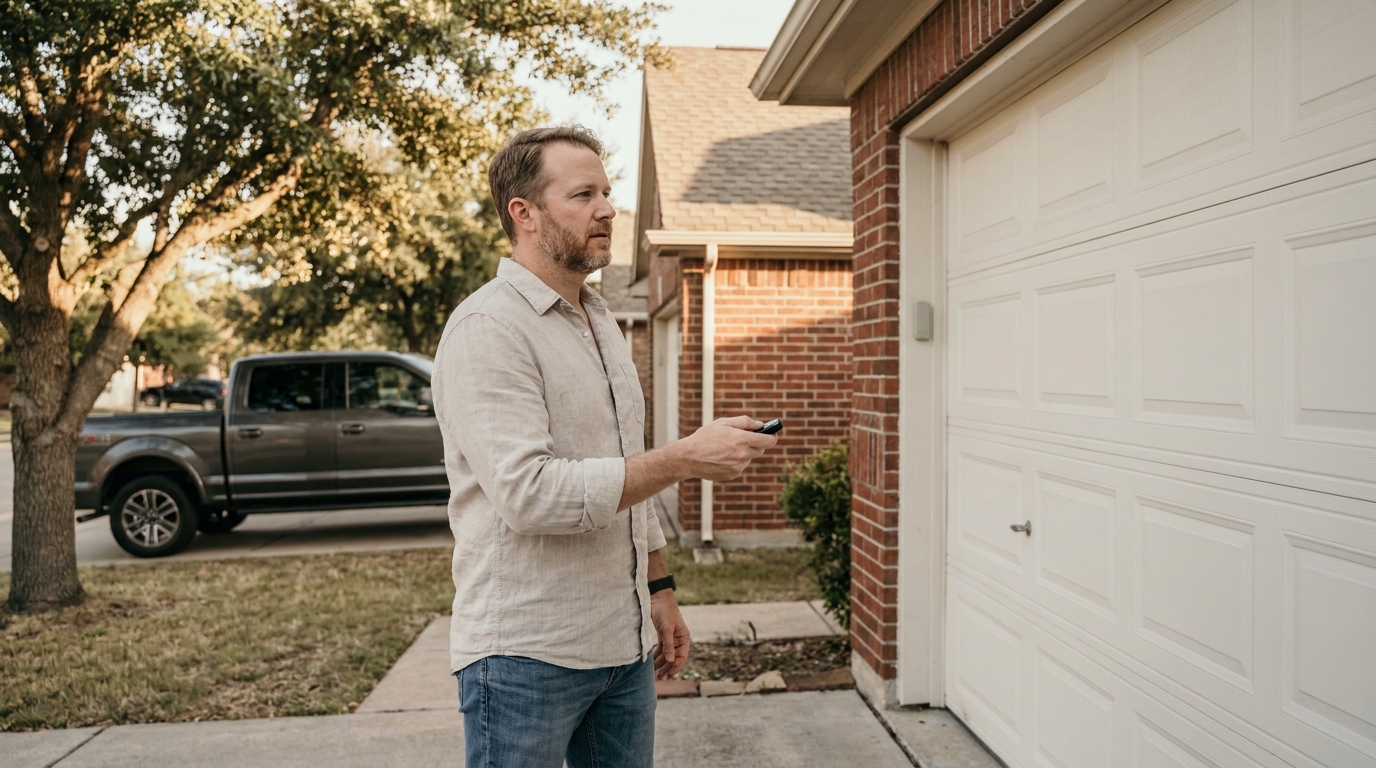
Garage Door Opener Not Working? 10 Causes & Fixes
Your garage door opener is not responding. Before you call for service, work through this diagnostic checklist — about half of all “opener not working” calls are resolved by something the homeowner can fix in five minutes.
Quick Diagnostic Flowchart
Start here:
-
Does the opener make any sound when you press the remote or wall button?
- No sound at all: Go to Causes 1–3
- Humming but door not moving: Go to Cause 5
- Normal operation sounds but door does not move: Go to Cause 7
- Door moves but reverses immediately: Go to Cause 6
-
Does the wall button work when the remote does not?
- Yes: Remote issue (Cause 2 or 3)
- No: Likely a power or logic board issue (Cause 1 or 4)
Cause 1: No Power to the Opener
Symptoms: Complete silence when pressing wall button or remote.
Check: Make sure the opener is plugged in. Check the outlet with another device. Check your breaker panel for a tripped circuit. During Texas summer peak demand events, GFCI outlets sometimes trip.
Fix: Reset the breaker or GFCI, plug in the opener, and test.
Cause 2: Dead Remote Battery
Symptoms: Wall button works, remote does not.
Check: Replace the battery in the remote. Most garage door remotes use a CR2032 or 9V battery — check the back panel.
Fix: New battery. Takes two minutes.
Cause 3: Remote Needs Reprogramming
Symptoms: Remote and wall button both recently stopped working, or remote just started acting intermittently.
Check: Try pressing and holding the “Learn” button on the opener unit (usually near the antenna wire), then pressing the remote button within 30 seconds.
Fix: Reprogramming per the opener’s instructions. If reprogramming does not help, the remote’s signal frequency may have drifted (less common) or the logic board may be failing.
Cause 4: Logic Board Failure
Symptoms: Opener is powered (light works, you hear a faint hum) but nothing responds.
Check: If a power surge recently occurred — from a storm, grid event, or lightning — the logic board may be fried.
Fix: Logic board replacement, typically $120–$200. On older openers (over 12 years), this is often the point at which replacement is more cost-effective than repair.
Cause 5: Broken Gear and Sprocket
Symptoms: Opener motor hums and runs but the door does not move.
Check: Listen closely — you may hear grinding. Look through the cover of the opener unit; if you can see a white plastic gear that is stripped or broken, that is your culprit.
Fix: Gear and sprocket replacement, typically $120–$180. This is one of the most common opener failures and is usually repairable rather than requiring full replacement.
Cause 6: Safety Sensors Out of Alignment
Symptoms: Door opens fine but immediately reverses on close (drops a few inches then goes back up).
Check: Look at the photo-eye sensors near the floor on each side of the door track. One has a steady green or amber light (transmitter), one should have a steady green light (receiver). If the receiver light is blinking or off, alignment is the issue.
Fix: Loosen the wing nut holding the sensor, align it so both sensors have steady lights, and retighten. If a sensor was physically damaged, replacement runs $60–$100.
Cause 7: Door Is Off Track or Spring Is Broken
Symptoms: Opener runs through its full travel cycle but door does not open — or door opens with extreme resistance.
Check: Disconnect the opener using the red emergency cord and try to lift the door manually. If it is very heavy, uneven, or will not move at all, a spring or cable issue is likely. If a loud bang preceded the problem, a spring almost certainly snapped.
Fix: Do not continue to run the opener against a broken spring or off-track door. Call for professional service. See our spring replacement service or off-track repair.
Cause 8: Travel Limit Settings Drifted
Symptoms: Door opens partway and stops, or closes partway and reverses.
Check: The opener’s travel limit screws (typically on the side of the unit) may have drifted.
Fix: Adjust the limit screws per the manual. Typically a clockwise turn for more travel, counterclockwise for less. Small adjustments — a quarter turn at a time.
Cause 9: Force Settings Too Low
Symptoms: Door reverses on close but sensors are fine, or door does not fully open.
Check: Press and hold the door closed while running the opener on close cycle. If it stops with force applied, the force setting is too low.
Fix: Adjust the force dial per your opener’s manual. Be conservative — over-adjusting force settings defeats the safety auto-reverse function.
Cause 10: Antenna or Signal Interference
Symptoms: Remote works sometimes but not others, or only works from certain positions.
Check: Look at the antenna wire hanging from the opener. It should hang straight down. Anything blocking the signal path (new appliances, LED bulbs of certain frequencies, security cameras) can cause interference.
Fix: Extend the antenna, reposition it, or try an LED bulb specifically rated as “garage door opener compatible” (regular LED bulbs commonly interfere with 315MHz and 390MHz opener frequencies).
When to Call a Professional
Call for service if:
- You suspect a broken spring (safety risk)
- The gear replacement or logic board is beyond your DIY comfort
- Sensor replacement is needed
- The door is off track or has visible structural damage
Mockingbird Garage Doors provides same-day opener repair across Houston and Austin. Call (713) 555-0192.